
Search visibility monitoring workflow for UAE websites
What this page covers
Search visibility monitoring workflow for UAE websites
Search visibility monitoring helps UAE teams see how Google and AI-powered search currently view a public website, which pages and hubs are discoverable, and where visibility may be limited.
A practical workflow starts with a website scan, then moves into fixing structural gaps, improving internal linking and sitemap quality, and tracking visibility over time as the site changes.
In brief
- Monitor both classic search and AI-powered search, because visibility may show up as rankings, impressions, indexed pages, or brand mentions in AI answers.
- Use a repeatable scan to identify visible pages, hubs, weak entry points, and discovery issues before deciding what to fix first.
- Review visibility regularly, because performance can shift with algorithm changes, competitor moves, feature rollouts, and content updates.
What to do
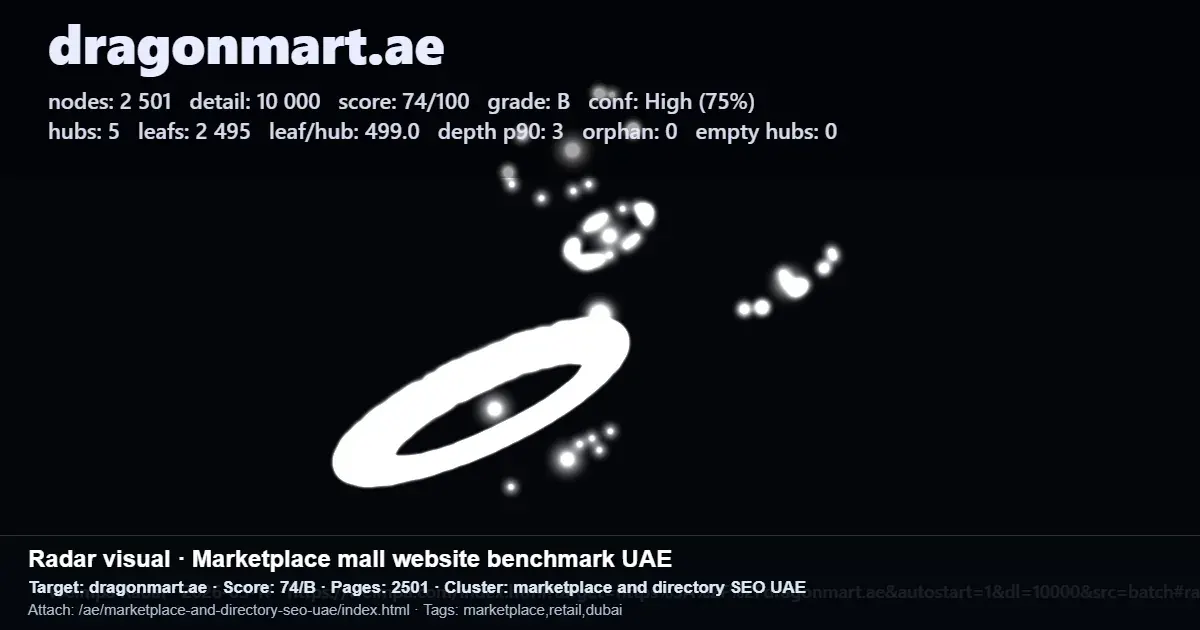
A grounded search visibility monitoring workflow starts with a clear diagnostic layer. The free Radar scan checks how a public website is structured, which pages and hubs are visible, where discovery is blocked, and what should be fixed first. That gives teams a practical starting point instead of relying on isolated metrics.
From there, the workflow should turn findings into search-layer improvements. If the scan shows structural gaps, the next steps may include demand mapping, hub and leaf page planning, evidence-backed pages, stronger internal linking, deployment, sitemap submission, and ongoing growth monitoring. For UAE websites, this is relevant across Dubai, Abu Dhabi, Sharjah, free zones, and search-led sectors.
Monitoring should not depend on one metric alone. Search visibility can change quickly, so it helps to track unusual drops, compare positions with impressions, and review whether key pages are still discoverable. Search Console data has limits, and AI search visibility may appear as mentions rather than direct clicks, so monitoring works best when it feeds into regular content and structure updates.
What to keep in mind
This workflow fits companies, marketers, SEO teams, agencies, and digital platforms that want a clearer view of how search engines and AI systems currently see their websites. It is especially useful for teams that want to build inbound visibility instead of depending only on paid acquisition.
A realistic limitation is that visibility is never perfectly stable or perfectly measured. Rankings, impressions, and AI mentions can move for reasons outside your control, and average position on its own does not explain the full picture. Repeated checks and broader signals give a more dependable view.
It also helps to stay practical about what monitoring can and cannot do. A scan can highlight visible pages, weak entry points, sitemap or access issues, and structural gaps, but improvement usually comes from follow-up work such as better page architecture, stronger internal linking, and steady iteration based on what the monitoring shows.