
Real estate portal indexing workflow for UAE property websites
What this page covers
Real estate portal indexing workflow for UAE property websites
For UAE property websites, portal indexing starts with a structure search engines can actually crawl and understand. The clearest pattern in the examples is the gap between large portals with strong hub coverage and smaller sites with limited or missing hub layers.
A practical workflow is to review how hubs, listings, community pages, project pages, and property-type pages connect, then verify which important sections are indexed and reachable. This helps teams spot where discovery is working and where coverage is weak or absent.
In brief
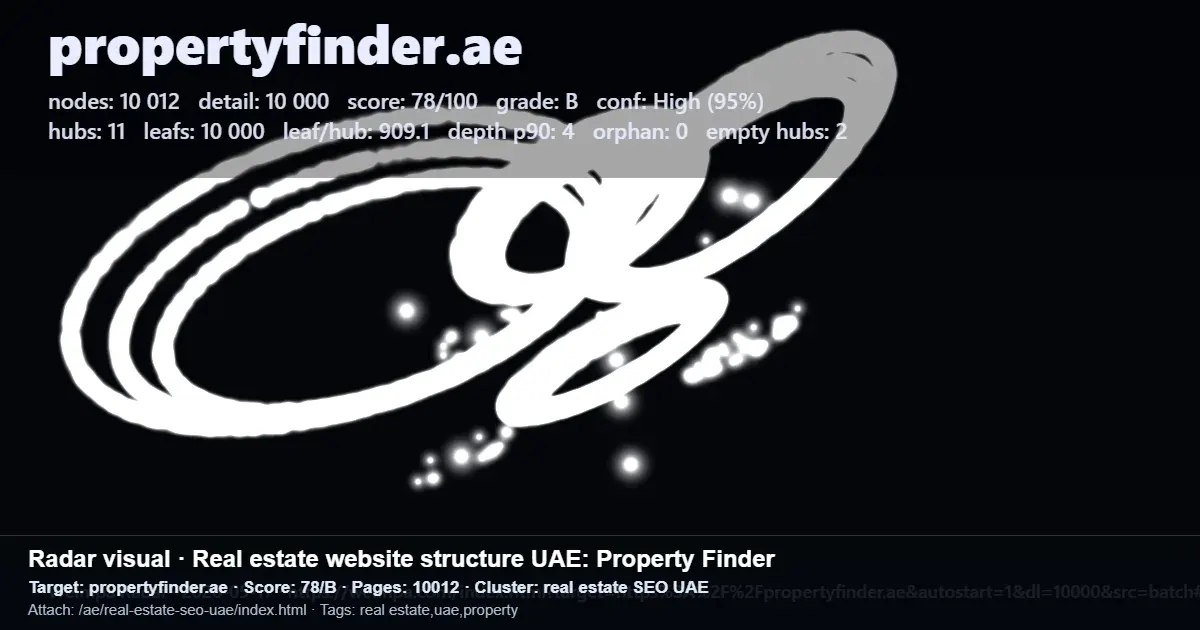
- A stronger portal structure usually has clear hubs feeding many leaf pages. In one example, Property Finder shows 11 hubs, around 10,000 leaf pages, and a score of 78 out of 100.
- Weak indexing often shows up when key sections have little or no hub support. In another example, a site with 84 pages has 0 hubs and a score of 4 out of 100.
- For UAE real estate sites, the workflow should focus on community, project, property-type, service, and listing paths, then check whether those pages are actually indexed and reachable.
What to do
Start by mapping the main search layers of the website. For a real estate portal, developer, or brokerage, that usually means hubs for areas, communities, projects, or property types, linked to deeper listing or detail pages. The contrast in the examples is useful: one site shows 11 hubs supporting a large leaf set, while another shows no hubs at all.
Next, check whether those sections can be discovered consistently. The supporting material points to common issues such as incomplete coverage of communities, projects, and property types, along with internal linking and sitemap setups that do not clearly connect hubs and listings. That makes it harder to tell which pages are truly indexed and reachable.
Then prioritise the gaps that affect coverage most. Thin community and location pages, generic service pages, and property landing pages that are not indexed can all weaken organic lead generation. A solid indexing workflow helps teams find weak entry points, blocked discovery paths, and sections that need stronger internal structure before adding more content.
What to keep in mind
This page is most relevant for UAE brokerages, developers, and portals that rely on community, service, property, location, project, or listing pages to capture organic demand. It is especially useful when teams feel important sections are not being discovered or when visibility shifts across many page types.
The examples here show that site structures can vary widely even within the same market. Propertyfinder.ae is shown with 10,012 pages, 11 hubs, and a score of 78 out of 100. Samana Developers is shown with 109 pages, 3 hubs, and a score of 58 out of 100. DAMAC Properties is shown with 84 pages, 0 hubs, and a score of 4 out of 100.
These snapshots are structural signals, not a guarantee of business results. They help frame where indexing work may need attention, such as missing entry points, weak hub-to-leaf connections, or incomplete inventory coverage. If the main issue is broader keyword strategy rather than page discovery and structure, this workflow is only one part of the answer.