
Marketplace and directory indexing checklist for UAE platforms
What this page covers
Marketplace and directory indexing checklist for UAE platforms
For UAE marketplaces and directories, indexing depends on whether search engines can clearly discover your hubs, leaf pages, and supporting paths across a large site.
A practical checklist starts with structure, discovery, and crawl weak spots. Radar is a free public website scan that shows which pages and hubs are visible and where discovery is being blocked.
In brief
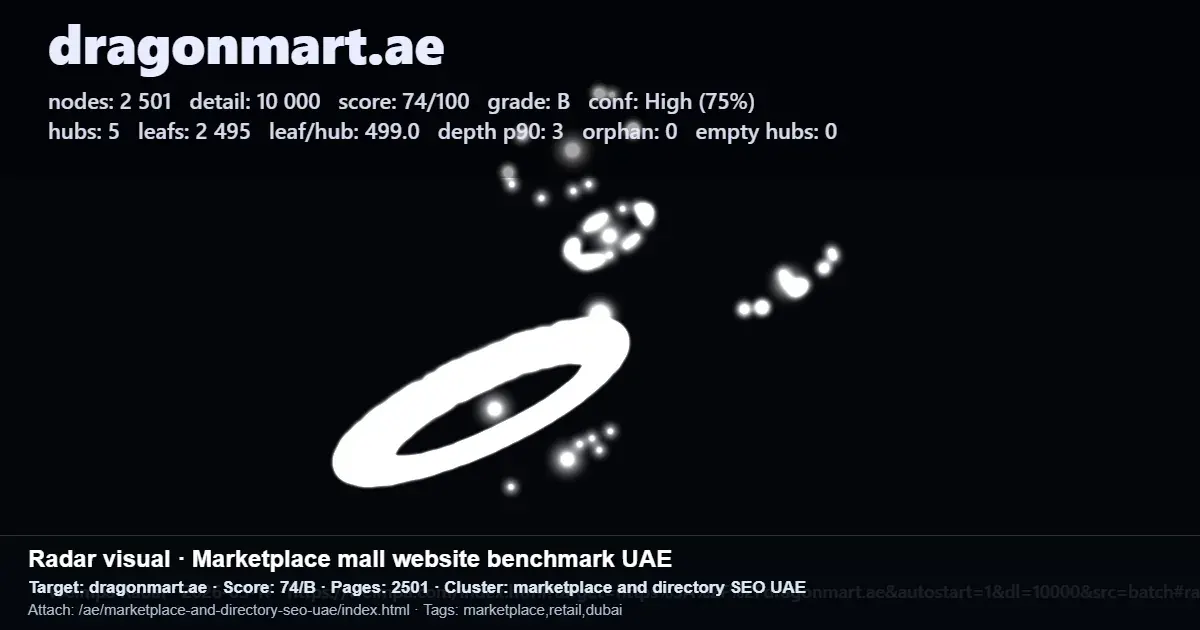
- Check that your platform exposes a clear hub-and-leaf structure. In one UAE marketplace benchmark, 5 hubs supported 2,495 leaves across 2,501 pages, with no orphan pages reported.
- Review scale and coverage, not just total page count. Another benchmark in the same cluster showed 16 pages, 3 hubs, 12 leaves, and 1 empty hub, pointing to much thinner indexable coverage.
- Use a diagnostic before publishing more listings. The recommended first step is a Radar scan to check visible pages and hubs, weak spots, and sitemap, robots, and home access issues.
What to do
A practical indexing checklist for a UAE platform starts with discovery. Confirm that the site exposes real hubs and leaves, that key sections are reachable from core entry points, and that empty hub areas are not wasting crawl paths. The available benchmarks show how different structures can look even within the same cluster.
Next, compare depth and coverage. One benchmarked marketplace showed 2,501 pages, 5 hubs, 2,495 leaves, a p90 depth of 3, and no orphan pages. A second benchmark showed 16 pages, 3 hubs, 12 leaves, a p90 depth of 4, and 1 empty hub. These examples suggest that indexing readiness depends on how much of the platform is actually surfaced in a crawlable structure.
If the structure is unclear, the recommended workflow is to start with Radar for a public scan, then use follow-up work to build the missing search layer. That can include demand mapping, hub-and-leaf page planning, internal linking, deployment, sitemap submission, and indexing support.
What to keep in mind
This page is most relevant for a UAE marketplace, directory, or digital platform team trying to understand why traffic can stall even as more listings or pages are added. It also helps teams that need a clearer way to structure providers, categories, use cases, and locations without overlap.
The evidence here is structural rather than performance-based. It focuses on signals such as visible hubs and leaves, page counts, depth, empty hubs, orphan pages, and discovery checks. It does not support promises about rankings, traffic growth, or timing, so the checklist should be used as a diagnostic starting point.
This approach is especially useful when internal SEO capacity is limited and manual checks do not scale across a large platform. The offer is centred on public website scans, graph visualisation, weak spot checks, and deeper support when a missing search layer needs to be planned and deployed.